Prefered browser: Microsoft Edge 120+, Google Chrome 120+, or Mozilla Firefox 115+ for best performance.

Genomsawit Website
Official Portal Of
Malaysian Oil Palm Genome Programme (MyOPGP)


Prefered browser: Microsoft Edge 120+, Google Chrome 120+, or Mozilla Firefox 115+ for best performance.
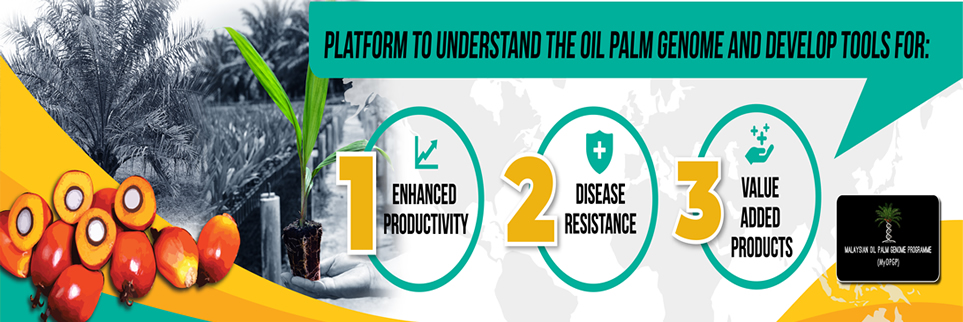
The goal of the Malaysian Oil Palm Genome Programme (MyOPGP) is to produce a draft sequence of the oil palm genome. The sequence will provide a deeper understanding of the genome architecture and become a resource for biomarker discovery and development of diagnostic tools. The programme was first initiated in 2004 to selectively sequence the hypomethylated regions of the genome, and was subsequently expanded to the whole genome, facilitated by advancements in sequencing technologies and bioinformatics.
Three oil palm genomes, representing the dura and pisifera fruit forms of E. guineensis and E. oleifera, were previously sequenced, assembled and annotated using a combination of Roche 454 and Illumina sequencing technologies, together with transcriptome and epigenome datasets.
In 2024, the E. guineensis reference genome was substantially improved to EG11 through the integration of PacBio long-read sequencing, proximity ligation sequencing, optical mapping and genetic map-guided assembly. The improved EG11 assembly comprises 16 pseudochromosomes with a total pseudochromosome length of approximately 1.78 Gb, representing about 99% of the estimated E. guineensis genome size. This chromosome-scale assembly provides markedly improved continuity, reduced scaffold number, increased scaffold N50 and lower gap content compared with the previous EG5 assembly. The updated genome also includes the most extensive E. guineensis gene annotation to date, with 46,697 predicted gene models,
providing a stronger reference for comparative genomics, structural variant analysis, marker discovery and genomics-assisted oil palm improvement.

The objectives of the programme are: